
Your ICP Is a Hypothesis Until Your Data Says Otherwise

A few months ago, I wrote about spinning my wheels with Shore GTM, and about the moment I realized I had created a solution looking for a problem. I ended that post by saying we had built a library of AI solutions mapped to the eight GTM OS pillars, and that I would share more soon.
This is the first installment. Over the next several weeks I will walk through each of the eight pillars and show what practical AI can look like when it is pointed at a specific go-to-market problem, rather than at the general idea of being “more productive,” “use agents to run our entire marketing department,” or “develop a fleet of AI SDRs.” The pillars come from the GTM Operating System developed by GTM Partners (Shore GTM is a certified partner), and they give me a way to find where revenue is getting stuck before anyone builds anything.
Why start with the ICP
The first pillar is Total Relevant Market, and it answers a simple question: who should you be selling to?
It sounds basic. But in my years as a CEO and CMO, it was the question most companies answered once, very early, and then rarely revisited. This was true even in my own companies. The ICP gets written based on what we think we know about customers and the deals that felt like they would apply here, and over time it hardens into fact: “this is our ICP.”
Unfortunately, what often happens is that the ICP is a series of “we think” assumptions that nobody has checked against the company’s own history. And everything downstream inherits the error. Marketing builds campaigns for it, sales prospects against it, and customer success inherits whoever was sold.
So ,when growth stalls, the team goes looking for a messaging problem or a pipeline problem. Rarely is it either, and more likely the team is aiming well-built programs at the wrong accounts.
Let me stop here and ask: when was the last time your team went beyond the “we think” ICP and looked at who your ideal customer really is, based on the deals you have won and the customers with the greatest lifetime value (LTV)? Give that a think.
That is why every Pillar 1 solution in the library starts in the same place.
Test the ICP before you automate it
ICP Back-Test.
This is the foundation, and nothing else in this pillar should be built without it. We take 18 months of won, lost, churned and expanded accounts out of the CRM and enrich them with firmographic, psychographic, behavioral, and trigger data. Then AI does the part that used to take weeks, which is reading the free-text fields. Notes, lost reasons and call summaries get classified into consistent attributes so they can be compared. From there we look at what the winners had in common, test that pattern against a holdout sample the analysis never saw, and deliver a weighted scoring rubric.
It usually changes at least one segment decision. And because every other build in this pillar runs on its output, every one of them gets better.
This is what it looks like:

Churn Pattern Analysis.
This runs on the same data, with one important twist: it looks at churned accounts as they were when they were sold, not when they left. That produces disqualifiers, the characteristics that predict a customer who will struggle. The reality is that disqualifiers are usually more valuable than qualifiers, because a bad-fit customer costs you twice. You pay for the selling effort up front because the sales cycle drags, and then you pay again in inflated service effort and churn.

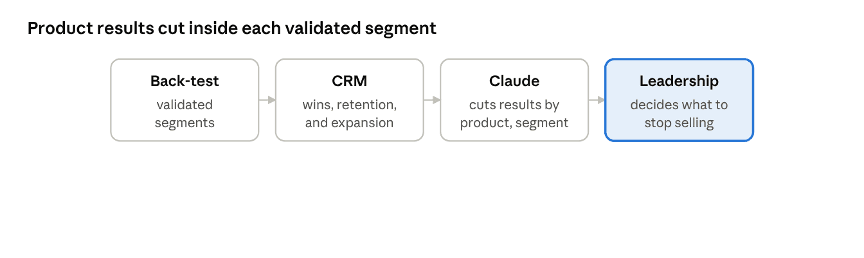
Product and Segment Performance Analysis. Once the segments are validated, we cut win rate, retention and expansion by product within each segment. It answers a question most companies settle by opinion, which is which products they should stop selling into which segments.
Build Automation Systems on Your Proven Foundation
Those three analyses should be rerun periodically as your customer base changes, so the team stays focused on the opportunities that close fastest and carry the greatest lifetime value. The next three are systems the team runs every day, and they only work because the analysis came first.
Automated Account Scoring Engine. The validated rubric gets encoded as scoring logic, run against the full database and open pipeline, and written back into the CRM on a weekly basis so the sales team can focus outreach on the best-fit accounts. Every score comes with reason codes, and that part is not optional. A rep will ignore a number on its own, but will work an account flagged as matching your best retained customers on size, tech stack and buying trigger. Tools like Clay and n8n make this far easier to build than it would have been a few years ago. But the tool set matters much less than the rubric underneath it.

Automated Look-Alike Discovery and Market Sizing. With the scoring rubric in hand, AI can search the relevant market for net-new accounts that match it, and count how many exist in each segment. The count matters as much as the list. Knowing how many good-fit accounts exist in each segment, and how many you already have, shows which segments have room to grow and which are close to tapped out. That is the starting point for deciding where to invest, which is the next pillar.

Automated Disqualification Filter. The disqualifiers from the churn analysis are applied when a new lead comes in, so a bad-fit account is routed to nurture or suppressed before it reaches a rep’s queue. Every suppressed record logs the reason. And for the first couple of months someone reviews what was filtered out, to make sure the filter is not throwing away good accounts.

The order matters more than the tools
Most companies want to start with the scoring engine or the look-alike list, because those feel like the AI part. But a scoring engine built on an untested ICP simply applies the old assumptions faster, and to every account in the database at once. In other words, AI does not fix a bad ICP. It just helps you chase the wrong accounts more efficiently.
I want to point out where AI does the work in this pillar (and where it does not). AI reads the notes and call summaries nobody had time to read, it enriches and matches accounts at a volume no team could handle, and it keeps the scores current. But AI does not decide who your customer is. Your own data does that, and leadership makes the final call.
So perhaps the right first question for 2027 planning is not which AI tools to buy, but whether the ICP everything else depends on has ever been tested.
Next week is Pillar 2, the Market Investment Map: deciding which segments deserve more of your sales and marketing budget, based on profit rather than revenue alone.
A few months ago, I wrote about spinning my wheels with Shore GTM, and about the moment I realized I had created a solution looking for a problem. I ended that post by saying we had built a library of AI solutions mapped to the eight GTM OS pillars, and that I would share more soon.
This is the first installment. Over the next several weeks I will walk through each of the eight pillars and show what practical AI can look like when it is pointed at a specific go-to-market problem, rather than at the general idea of being “more productive,” “use agents to run our entire marketing department,” or “develop a fleet of AI SDRs.” The pillars come from the GTM Operating System developed by GTM Partners (Shore GTM is a certified partner), and they give me a way to find where revenue is getting stuck before anyone builds anything.
Why start with the ICP
The first pillar is Total Relevant Market, and it answers a simple question: who should you be selling to?
It sounds basic. But in my years as a CEO and CMO, it was the question most companies answered once, very early, and then rarely revisited. This was true even in my own companies. The ICP gets written based on what we think we know about customers and the deals that felt like they would apply here, and over time it hardens into fact: “this is our ICP.”
Unfortunately, what often happens is that the ICP is a series of “we think” assumptions that nobody has checked against the company’s own history. And everything downstream inherits the error. Marketing builds campaigns for it, sales prospects against it, and customer success inherits whoever was sold.
So ,when growth stalls, the team goes looking for a messaging problem or a pipeline problem. Rarely is it either, and more likely the team is aiming well-built programs at the wrong accounts.
Let me stop here and ask: when was the last time your team went beyond the “we think” ICP and looked at who your ideal customer really is, based on the deals you have won and the customers with the greatest lifetime value (LTV)? Give that a think.
That is why every Pillar 1 solution in the library starts in the same place.
Test the ICP before you automate it
ICP Back-Test.
This is the foundation, and nothing else in this pillar should be built without it. We take 18 months of won, lost, churned and expanded accounts out of the CRM and enrich them with firmographic, psychographic, behavioral, and trigger data. Then AI does the part that used to take weeks, which is reading the free-text fields. Notes, lost reasons and call summaries get classified into consistent attributes so they can be compared. From there we look at what the winners had in common, test that pattern against a holdout sample the analysis never saw, and deliver a weighted scoring rubric.
It usually changes at least one segment decision. And because every other build in this pillar runs on its output, every one of them gets better.
This is what it looks like:
Churn Pattern Analysis.
This runs on the same data, with one important twist: it looks at churned accounts as they were when they were sold, not when they left. That produces disqualifiers, the characteristics that predict a customer who will struggle. The reality is that disqualifiers are usually more valuable than qualifiers, because a bad-fit customer costs you twice. You pay for the selling effort up front because the sales cycle drags, and then you pay again in inflated service effort and churn.
Product and Segment Performance Analysis. Once the segments are validated, we cut win rate, retention and expansion by product within each segment. It answers a question most companies settle by opinion, which is which products they should stop selling into which segments.
Build Automation Systems on Your Proven Foundation
Those three analyses should be rerun periodically as your customer base changes, so the team stays focused on the opportunities that close fastest and carry the greatest lifetime value. The next three are systems the team runs every day, and they only work because the analysis came first.
Automated Account Scoring Engine. The validated rubric gets encoded as scoring logic, run against the full database and open pipeline, and written back into the CRM on a weekly basis so the sales team can focus outreach on the best-fit accounts. Every score comes with reason codes, and that part is not optional. A rep will ignore a number on its own, but will work an account flagged as matching your best retained customers on size, tech stack and buying trigger. Tools like Clay and n8n make this far easier to build than it would have been a few years ago. But the tool set matters much less than the rubric underneath it.
Automated Look-Alike Discovery and Market Sizing. With the scoring rubric in hand, AI can search the relevant market for net-new accounts that match it, and count how many exist in each segment. The count matters as much as the list. Knowing how many good-fit accounts exist in each segment, and how many you already have, shows which segments have room to grow and which are close to tapped out. That is the starting point for deciding where to invest, which is the next pillar.
Automated Disqualification Filter. The disqualifiers from the churn analysis are applied when a new lead comes in, so a bad-fit account is routed to nurture or suppressed before it reaches a rep’s queue. Every suppressed record logs the reason. And for the first couple of months someone reviews what was filtered out, to make sure the filter is not throwing away good accounts.
The order matters more than the tools
Most companies want to start with the scoring engine or the look-alike list, because those feel like the AI part. But a scoring engine built on an untested ICP simply applies the old assumptions faster, and to every account in the database at once. In other words, AI does not fix a bad ICP. It just helps you chase the wrong accounts more efficiently.
I want to point out where AI does the work in this pillar (and where it does not). AI reads the notes and call summaries nobody had time to read, it enriches and matches accounts at a volume no team could handle, and it keeps the scores current. But AI does not decide who your customer is. Your own data does that, and leadership makes the final call.
So perhaps the right first question for 2027 planning is not which AI tools to buy, but whether the ICP everything else depends on has ever been tested.
Next week is Pillar 2, the Market Investment Map: deciding which segments deserve more of your sales and marketing budget, based on profit rather than revenue alone.
Related Articles
Practical AI for the GTM, Part 1: Total Relevant Market
Your ICP Is a Hypothesis Until Your Data Says Otherwise
Before you automate scoring or prospecting, test your ICP against the deals you have won. AI does not fix a bad ICP. It just helps you chase the wrong accounts more efficiently.

Where Agency Growth Breaks, Part 1 of 8
The Agency Dilemma: A Classic Case of Cobbler's Children
Agencies plan carefully for every client except themselves. Here is why that catches up with them, and a ten-minute test to see where your agency’s growth is stuck.
Patrick Rooney
5 minute read

Practical AI for the GTM, Part 3: Brand & Demand
Your messaging may not be as great as you think
Building a unique and distinguished brand is made up of several parts: the point of view itself, the messaging and positioning that carry it, and how you take it to market, whether through inbound, outbound, partners or something else. AI can test whether the messaging that brings your point of view to life is landing, help keep the story consistent, and then help you produce more.
Patrick Rooney
5 min read

AI STRATEGY
If your AI projects are flailing, it’s not the tools. It’s the sequence.
Most AI initiatives stall not from a lack of technology but from a lack of structure. Here's why sequencing is the variable that changes everything, and how to get it right.
Patrick Rooney
5 min read
GTM PERFORMANCE
The difference between AI activity and AI performance, and why most GTM teams are stuck in the first one.
Individual AI adoption is everywhere. Organizational AI performance is rare. Understanding the gap is the first step to closing it.
Patrick Rooney
6 min read

ADOPTION
Your AI transformation won't be won or lost on the technology. It'll be won or lost on the people.
The technology is extraordinary. That's not the hard part. The hard part is asking people to change how they've worked for their entire careers, and doing it with the clarity, empathy, and honesty that kind of change requires.
Patrick Rooney
7 min read

Turn AI activity into GTM performance.
Useful Links
Connect
Privacy Policy
Terms of Service
Legal
© 2026 Shore GTM LLC. All rights reserved.
Turn AI activity into GTM performance.
Useful Links
Connect
Privacy Policy
Terms of Service
Legal
© 2026 Shore GTM LLC. All rights reserved.
Turn AI activity into GTM performance.
Useful Links
Connect
Privacy Policy
Terms of Service
Legal
© 2026 Shore GTM LLC. All rights reserved.